B) False
Correct Answer

verified
Correct Answer
verified
A) increases.
B) decreases.
C) increases and then decreases.
D) decreases and then increases.
E) remains constant.
G) C) and D)
Correct Answer
verified
Correct Answer
verified
Correct Answer
verified
A, 4 m; B,...View Answer
Correct Answer
verified
View Answer
A) 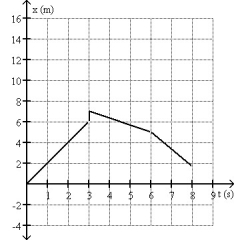
B) 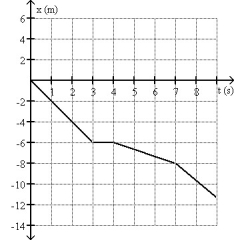
C) 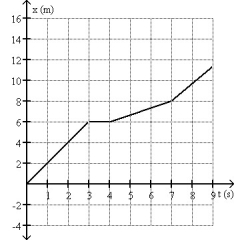
D) 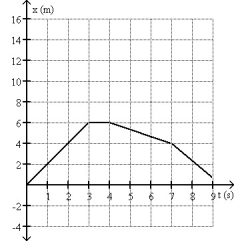
E) None of the above graphs could represent the motion described.
G) A) and C)
Correct Answer
verified
Correct Answer
verified
A) a horizontal straight line.
B) a vertical straight line.
C) a straight line making an angle with the time axis.
D) a parabolic curve.
E) a hyperbolic curve.
G) A) and B)
Correct Answer
verified
Correct Answer
verified
A) always
B) never
C) only when the velocity is constant
D) only when the velocity is increasing at a constant rate
E) only when the velocity is decreasing at a constant rate
G) C) and D)
Correct Answer
verified
Correct Answer
verified
A) always
B) never
C) only when the acceleration is constant
D) only when the acceleration is increasing at a constant rate
E) only when the acceleration is decreasing at a constant rate
G) B) and E)
Correct Answer
verified
Correct Answer
verified
Correct Answer
verified
Correct Answer
verified
A) The acceleration must be constantly increasing.
B) The acceleration must be constantly decreasing.
C) The acceleration must be constant.
D) This can only occur if there is no acceleration.
E) This is impossible.
G) A) and D)
Correct Answer
verified
Correct Answer
verified
A) -1.0 m
B) 3.0 m
C) 1.0 m
D) 19.5 m
E) 5.0 m
G) None of the above
Correct Answer
verified
Correct Answer
verified
A) 20 m
B) 18 m
C) 16 m
D) 14 m
E) 12 m
G) B) and E)
Correct Answer
verified
Correct Answer
verified
A) 10.2 m/s
B) 14.5 m/s
C) 105 m/s
D) 210 m/s
E) 315 m/s
G) A) and E)
Correct Answer
verified
Correct Answer
verified
A) a horizontal straight line.
B) a vertical straight line.
C) a straight line making an angle with the time axis.
D) a parabolic curve.
E) a hyperbolic curve.
G) D) and E)
Correct Answer
verified
Correct Answer
verified
A) 0.33 m/s2
B) 1.7 m/ s2
C) 2.0 m/ s2
D) 2.5 m/ s2
E) 3.0 m/ s2
G) B) and C)
Correct Answer
verified
Correct Answer
verified
A) moving with constant non-zero speed.
B) moving with constant non-zero acceleration.
C) at rest.
D) moving with infinite speed.
E) none of the above
G) A) and C)
Correct Answer
verified
Correct Answer
verified
A) The car undergoes constant acceleration of 0.500 m/s2 during the time from t = 0.00 s to t = 8.0 s.
B) The car undergoes constant acceleration of 4.00 m/s2 during the time from t = 0.00 s to t = 8.0 s
C) The car has zero acceleration during the time from t = 0.00 s to t = 8.0 s
D) The average acceleration of the car is 0.500 m/s2 during the time from t = 0.00 s to t = 8.0 s
E) The average acceleration of the car is 4.00 m/s2 during the time from t = 0.00 s to t = 8.0 s
G) B) and E)
Correct Answer
verified
Correct Answer
verified
A) 5.17 s
B) 10.0 s
C) 11.9 s
D) 20.4 s
E) A never catches up.
G) None of the above
Correct Answer
verified
Correct Answer
verified
A) The displacement is either greater than or equal to the distance traveled.
B) The displacement is always equal to the distance traveled.
C) The displacement is either less than or equal to the distance traveled.
D) The displacement can be either greater than, smaller than, or equal to the distance traveled.
E) If the displacement is equal to zero, then the distance traveled will also equal zero.
G) A) and C)
Correct Answer
verified
Correct Answer
verified
A) 4.15 m/s
B) 5.85 m/s
C) 4.60 m/s
D) 5.21 m/s
E) 3.85 m/s
G) A) and B)
Correct Answer
verified
Correct Answer
verified
A) 3.00 m/s
B) 11.0 m/s
C) 27.0 m/s
D) 13.0 m/s
E) 7.00 m/s
G) B) and C)
Correct Answer
verified
Correct Answer
verified
Showing 41 - 60 of 119
Related Exams